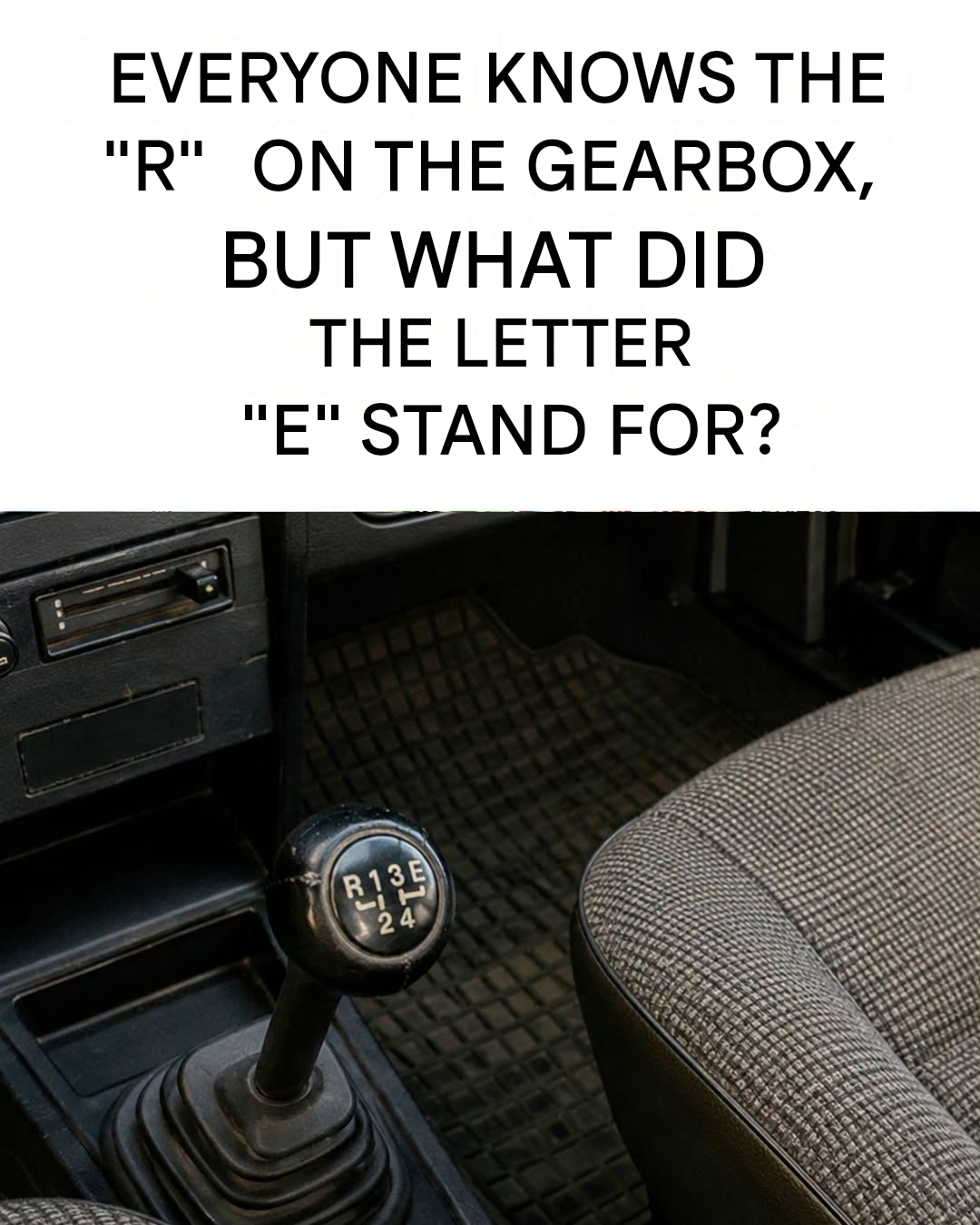
Anyone who has driven a car with a manual transmission is familiar with the numbers on the knob and the letter R , used to indicate reverse. On older cars, however, another letter could also appear: the E.
Today it has become a rarity and many drivers no longer remember its meaning. It did not indicate an electric mode or even a specific function of the engine: it was mainly linked to the need to reduce fuel consumption .
What did the letter E on the gear shift mean?
The E on the gearbox generally stood for “Economy”, a term used to identify a particularly long gear ratio designed for travelling while consuming less fuel.
This solution was found especially on some European cars between the 1970s and 1980s. In certain models, the E practically replaced the normal numerical indication of the last gear.
The principle was simple: once a suitable speed was reached, the driver would engage Economy gear to allow the engine to work at a lower rev number .
How the Economy Gear Worked
E gear had a long ratio, conceptually similar to what for many years was called overdrive .
At constant speed, especially on fast roads, it allowed you to maintain a high speed without revving the engine too quickly.
The advantage was mainly in fuel consumption. Lower engine revs could mean less fuel demand , as well as a more relaxed ride and reduced noise during long journeys.
It wasn’t an “Economy mode” like those found on modern cars. It was a real gear ratio, selected directly by the driver using the lever.
Why some cars had E instead of fifth gear
The spread of these reports must be read in the context of the automotive industry of the 1970s and 1980s.
After the oil crises, reducing fuel consumption became an increasingly important priority for manufacturers. One of the most immediate solutions was to add a longer top gear.
On some cars this gear was simply referred to as fifth, while on others the manufacturer preferred to use the letter E to underline its economic function .
Its presence on the knob also reminded the driver that that gear was designed primarily for maintaining speed and not for achieving maximum acceleration.
When the E was used on the gearbox
Economy gear was at its best especially when driving at a constant speed.
On a flat road or highway, it allowed the engine to maintain a lower rev. On hills or when greater acceleration was needed, it was necessary to shift down to a lower gear.
The principle is still present in modern cars. Even in current manual transmissions, fifth and sixth gears often have long ratios designed to keep engine speed low during transfers.
What has changed most is the way this function is indicated and managed.
Why the letter E disappeared from manual gearboxes
As automobiles evolved, the E gradually lost its usefulness as a separate designation.
Manual gearboxes first went to five and then to six speeds, while electronics, injection systems and engine management allowed for further optimisation of fuel consumption.
Modern cars have also introduced gear shift indicators and Eco modes , which can suggest when to shift up a gear or modify certain vehicle parameters to improve efficiency.
At the same time, the growing popularity of automatic transmissions has further reduced the need to manually select a specific gear for savings.
The E on the gearshift is a little piece of car history
Today, finding an E on the gear knob almost always means you are looking at a car from a few decades ago.
That single letter tells the story of a particular phase in the history of the automobile, when manufacturers were looking for simple mechanical solutions to reduce fuel consumption and the driver had an even more direct role in managing the transmission.
The “E” stood for Economy and indicated a high gear ratio, best used when cruising at a constant speed. This feature has now almost disappeared, but the underlying principle is still present in the higher gears of modern cars.